Rennie's River Duck Race Fundraiser – Rennie's River Development Foundation

Now in its 23nd Year, Quidi Vidi / Rennie’s River Development Foundation Annual Fundraiser – The RBC Rennie’s River Duck Race –was launched at the Suncor Energy Fluvarium on Thursday, July 28th, 2011. An annual tradition each September, Rennie’s River in St. John’s, is the scene of  3,600 yellow rubber ducks ‘racing’ their way down the river to the finish line on Kings Bridge Road. The first three ducks ‘across the line’ win prizes for their sponsors! This year the RBC Rennie’s River Duck Race Prizes is offering the opportunity for you to treat yourself…to a family trip for 4 to Western Newfoundland!

1st Prize – Win a trip to Western Newfoundland – Flights compliments of Provincial Airlines, Accommodations, and Family activities

2Nd Prize – Limited Edition Print – “Fourteen Racers” – Randy Dawe Photography & Framing

3rd Prize – RBC Blue Water Visa Gift Card- $250.00

Ducks can be sponsored for only $10.00, with tickets available at the Suncor Energy Fluvarium and all RBC Branches in the St. John’s Area.
Call 722- 3825 today for your duck!

Youth Leadership Training with Canadian Youth and the GO Project

Time: 10:00p – 2:30p, Friday, July 29, 2011
Location:  St. Paul’s Church, Robin Hood Bay, St. Philip’s Beach
Description:    MI Ocean Net will be hosting a special event with the ‘GO Project’ and youth from across Canada on Friday, Jul29.11.  The day will start with a motivating and empowering discussion on some truths about sustainability, followed by a guided tour of the Robin Hood Bay facilities, and finishing the day with a cleanup of St. Philip’s Beach.  MI Ocean Net volunteers are invited to join in the beach cleanup at 12:30p, Friday, July 29 on St. Philip’s beach.  Bring some friends, join us on your lunch break, and we’ll help make a difference TOGETHER!

Schedule:

10:00a:  MI Ocean Net’s empowering “Our Wake Up Call” slideshow and discussion

11:15a:   Guided tour of Robin Hood Bay facilities

12:30p:  Cleanup of St. Philip’s Beach


Three Cheers for Composting

As part of the 3rd annual Seeds to Supper Folk Life Festival several events are taking place throughout the month of August hosted by the Heritage Foundation of Newfoundland and Labrador.

Name of Event: Three Cheers for Composting!
Date: August 20th, 2011
Start Time: 10:30am
End Time:11:30am
Cost: Free
Location: MUN Botanical Gardens Mount Scio Road.
Website: www.mun.ca/botgarden
Contact Name: Anne Madden
Contact Email: bgprograms@mun.ca
Description of event: Growing healthy plants, including our food, starts with healthy soil. At MUN Botanical Garden we make our own – with fabulous results. All organic material (anything produced by a living organism) is recycled through a combination of natural biological and chemical processes. When we compost, we utilize natural processes. This presentation will introduce the practical steps of starting composting, indoors and out. The indoor presentation will be followed by a short walk in the garden to view some compost bins.

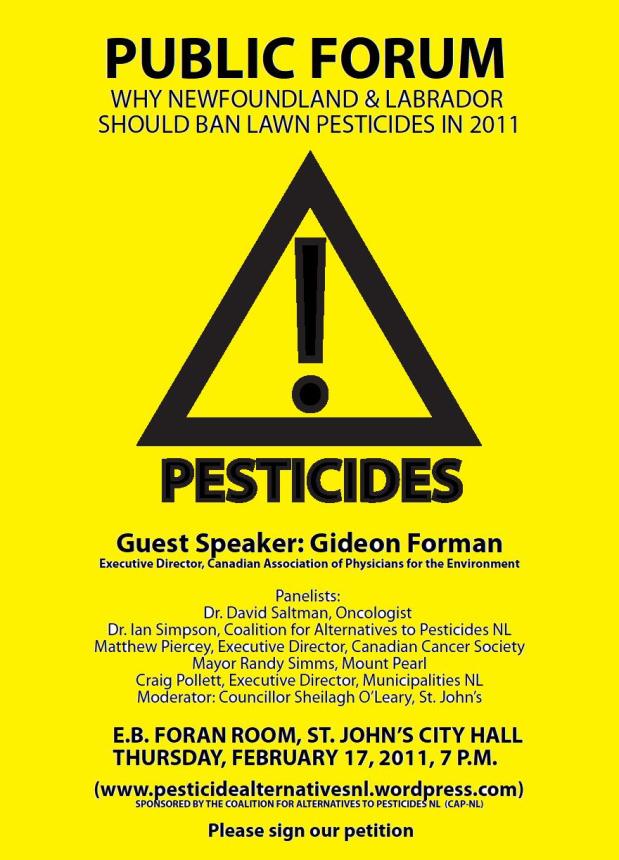
Cosmetic pesticide ban coming in 2012

Cosmetic pesticide ban coming in 2012

As of 2012, Newfoundland and Labrador will join the maritime provinces, Quebec and Ontario in banning the sale and use of cosmetic pesticides. That announcement was made last Thursday by Environment and Conservation Minister Ross Wiseman, following many years of dedicated activism by a number of concerned citizens and organisations.


Most recently, efforts by NLEN member organisation the Coalition for Alternatives to Pesticides–NL, served to highlight the unnecessary environmental and human health risks posed by cosmetic pesticide use, and rally public support for a ban.

Cosmetic pesticide use will continue for the remainder of the 2011 spray season. For residents of the Northeast Avalon region, please consult or subscribe to the daily Spray Advisory to learn if weather conditions permit spraying, and to gather tips on how to care for your lawn using natural techniques.

Read news release from the Department of Environment and Conservation: Ban Implemented on Cosmetic Pesticides for Lawn Care

Boreal Poetry Garden

In honor of the UN International Year of Forests 2011, join Marlene Creates as she leads a walk with readings of site-specific poems in The Boreal Poetry Garden — six acres of boreal forest where she lives in Portugal Cove.

After the walk, we will gather around a bonfire and have some refreshments while we enjoy a reading by an invited guest poet.

Plus, a new art installation by Marlene Creates will be launched:

Our Lives Concurrent for 58 Years Until the Hurricane, Blast Hole Pond Road, Newfoundland 2010.

with the assistance of ecologist Andrew Trant

Sat. August 23 with guest poet Tom Dawe

All events at 7:30 pm and weather permitting.

Limited to 25 people. Advance registration required.

For directions and to register:

marlene.creates@nf.sympatico.ca

or phone 709.895.1020

$15 general; $10 for students, seniors, unwaged.

with the assistance of the Newfoundland and Labrador Arts Council

About The Boreal Poetry Garden

This project uses words in situ to commemorate certain fleeting moments of Marlene Creates’s interaction with the place where she lives. Within these six acres there is a multitude of microhabitats: dark spruce and fir thickets; a steep wooded droke; a windblown tolt with goowiddy and tuckamore; a rattling brook called the Blast Hole Pond River; an overgrown bawn; and moss-covered volcanic rock up to 1,000 million years old. The Boreal Poetry Garden was featured on Bravo! TV.

Wow! Enchanted! Bewildering! What a place for reverie. –RR

Moss cushioned steps, smart words, chuckles… a wonderful sensory experience. –CD

Walking along the wooded trails, my feet, my ears, eyes & nose are Happy, Happy, Happy. –SD

Magical, momentary, evocative, grounding — beautiful. –KK

If you require roasted marshmallows or sublime poetry, please visit Blast Hole Pond Road. –JMI

Keeping woodland caribou in the boreal forest: Big challenge, immense opportunity

Keeping woodland caribou in the boreal forest: Big challenge, immense opportunity

(Photo: flickr.com/Rosino)

Woodland caribou, once abundant throughout much of mainland Canada and the northern United States, have been a major source of concern in recent decades due to significant declines in their population and loss of about half of their historic range.

To help inform decision makers and the public at large, the International Boreal Conservation Science Panel has published Keeping woodland caribou in the boreal forest: Big challenge, immense opportunity as a guide for conserving woodland caribou over the long term. It provides a broad overview of the state of woodland caribou, leading causes of their decline, and concludes with proactive steps needed to be taken to ensure this iconic species is not lost forever.

Floral Art Show – MUN Botanical Garden

The Floral Art Group of the Newfoundland Horticultural Society will present a floral art show at MUN Botanical Garden on Saturday, July 16 (noon – 5 p.m.) & Sunday, July 17 (10 a.m. – 4 p.m.).  Admission is free.  For more information on the Newfoundland Horticultural Society, please visit: http://nfldhort.dhs.org/.

For more information please call 864-8590, e-mail bgprograms@mun.ca or visit the Garden’s website at www.mun.ca/botgarden.  

Atlantic Provinces Urged to Increase Climate Change Action; NL gets failing grade on climate initiatives

Halifax, Nova Scotia – July 8 2011 – A coalition of Atlantic Canadian environmental groups have released report cards outlining the progress Atlantic Provinces have made on their commitments under the 2001 Climate Change Action Plan of the New England Governors and Eastern Canadian Premiers (NEG-ECP). The annual NEG-ECP meeting is being held in Halifax July 11-13.

The Atlantic Canada Sustainable Energy Coalition (ACSEC) has monitored the progress of NEG-ECP members toward their objectives since 2001. ACSEC is a coalition of non-governmental organizations comprised of the Ecology Action Centre, Sierra Club Canada – Atlantic, the Conservation Council of New Brunswick, and the Environmental Coalition of Prince Edward Island.

“The NEG-ECP Climate Change Action Plan has provided the framework for the region’s provincial and state policies on energy and climate change over the past decade,” explains Catherine Abreu, ACSEC’s Regional Facilitator.

Each of the Atlantic Provinces, except for PEI, fell short of achieving the 2010 milestone of reducing emissions to 1990 levels. In 2009, the last year for which data are available, greenhouse gas emissions in Nova Scotia, New Brunswick, and Newfoundland were 9.5%, 15.4% and 2.7% above 1990 levels, respectively. Provinces revised their commitment to reducing to 1990 levels by 2012.

ACSEC members agree that more aggressive regional greenhouse gas emissions reductions targets are required to avoid destabilizing the global climate. To support Atlantic Provinces meeting their 2012 goal and reducing emissions further by 2020, a second phase of the NEG-ECP Climate Change Action Plan must be implemented.

ACSEC urges the NEG-ECP to adopt a scientifically relevant target of 25% below 1990 GHG levels by 2020 in a second commitment period of the regional Climate Change Action Plan. 

  NB NL NS PEI
Overall Grade B D- B B
Greenhouse Gas Emissions A C+ B+ A
Energy Efficiency A D- A B-
Renewables B F B B+
Transportation D F D D
Regional Policy Integration + Cooperation A- A- A- A-

“The glaring gap in Atlantic Canada’s efforts to do its share to fight global warming is in the area of transportation,” says David Coon of New Brunswick-based Conservation Council. “Emissions from transportation are on the rise in every province,” adds Tony Reddin of the Environmental Coalition of Prince Edward Island. While PEI’s total emissions are down from 1990 levels, road transportation emissions have risen 22%. “Priority must be placed on creating public transportation infrastructure in the Atlantic Provinces and developing an integrated sustainable transportation plan for the region,” concludes Reddin.

“The creation of an Atlantic public transportation authority to develop and operate public transportation for the region is required. If we can have a regional lottery organization to coordinate gambling, we should be able to do the same for public transportation,” says ACSEC Coordinator, Catherine Abreu.

Newfoundland and Labrador is the only province that has not yet implemented policies mandating increased electricity generation from renewable sources. Gretchen Fitzgerald of Sierra Club’s Atlantic Canada chapter says continued and increased support for renewables is essential. “The Provinces can do a better job of developing complementary policies that enhance the role of renewables in Atlantic Canada. Investing in provincial and regional grid systems and moving away from large-scale, centralized electricity production will help us get there.”

New Brunswick and Nova Scotia lead the way in the area of efficiency. Both provinces have Energy Efficiency Agencies. “Energy efficiency and conservation are the most economical ways to simultaneously reduce emissions and save rate payers money,” says Brennan Vogel of Nova Scotia-based Ecology Action Centre. “Further establishing aggressive and innovative efficiency programs and services for all fuel types, including home heating fuels, can transform energy use and reduce emissions in the region.”

“We’ve seen unprecedented cooperation between the Atlantic Provinces on energy issues in recent years,” observes Abreu. ACSEC members agree that regional initiatives like the Atlantic Energy Gateway and NEG-ECP are vital, especially in the absence of strong Federal-level guidance on energy and climate change policy. “We emphasize that such initiatives must include representation from all levels of concern in Atlantic Canadian communities. ACSEC also cautions against losing sight of the ultimate goal – reducing emissions and turning the tide on climate change.”

ACSEC would like to see the NEG-ECP improve regional communities’ abilities to adapt as they confront the already extensive impacts of climate upheaval.

In 2007 an interim review of the Climate Change Action Plan suggested regional governments focus their efforts on four priority areas. ACSEC has graded each of the Atlantic Provinces on their progress in these areas as well as their emissions reductions.

For copies of the Nova Scotia Report Card and more information, contact:

Catherine Abreu
Regional Coordinator
ACSEC
902 442 0199
acsec@ecologyaction.ca

Brennan Vogel
Energy Coordinator
Ecology Action Centre
902 442 0199
energy@ecologyaction.ca

For Newfoundland, New Brunswick, & PEI, Contact:

Gretchen Fitzgerald
Director
Sierra Club Canada – Atlantic Canada Chapter
902 444 3113
gretchenf@sierraclub.ca  

David Coon
Executive Director
Conservation Council of New Brunswick
506 458 8747
dcoon@conservationcouncil.ca

Tony Reddin
Energy Coordinator
Environmental Coalition of Prince Edward Island
902 675 4093
ecopei.project@gmail.com